What if all the
glaciers melted?
10 unprecedented semi fictional maps of a country shaken by rising sea levels
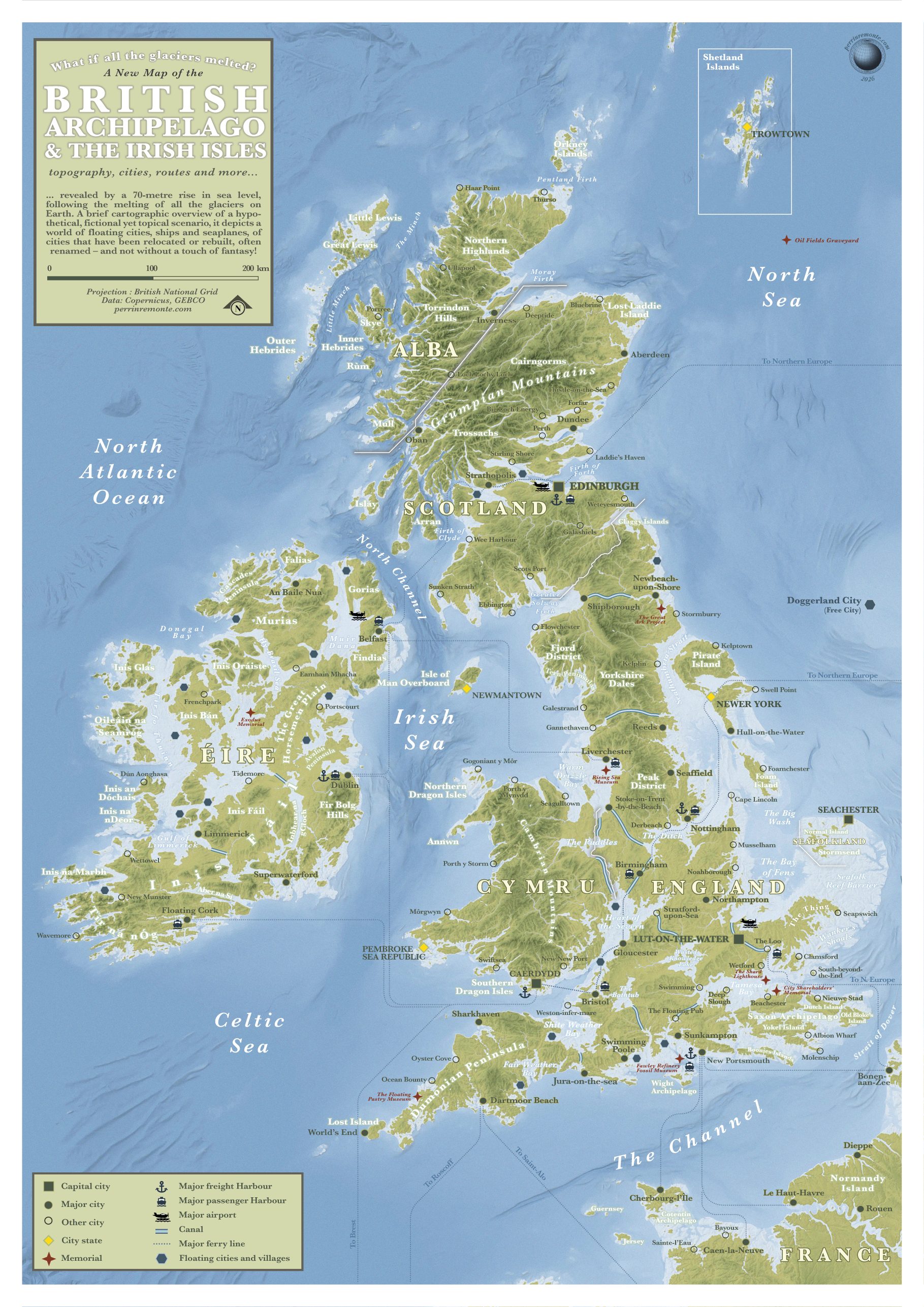
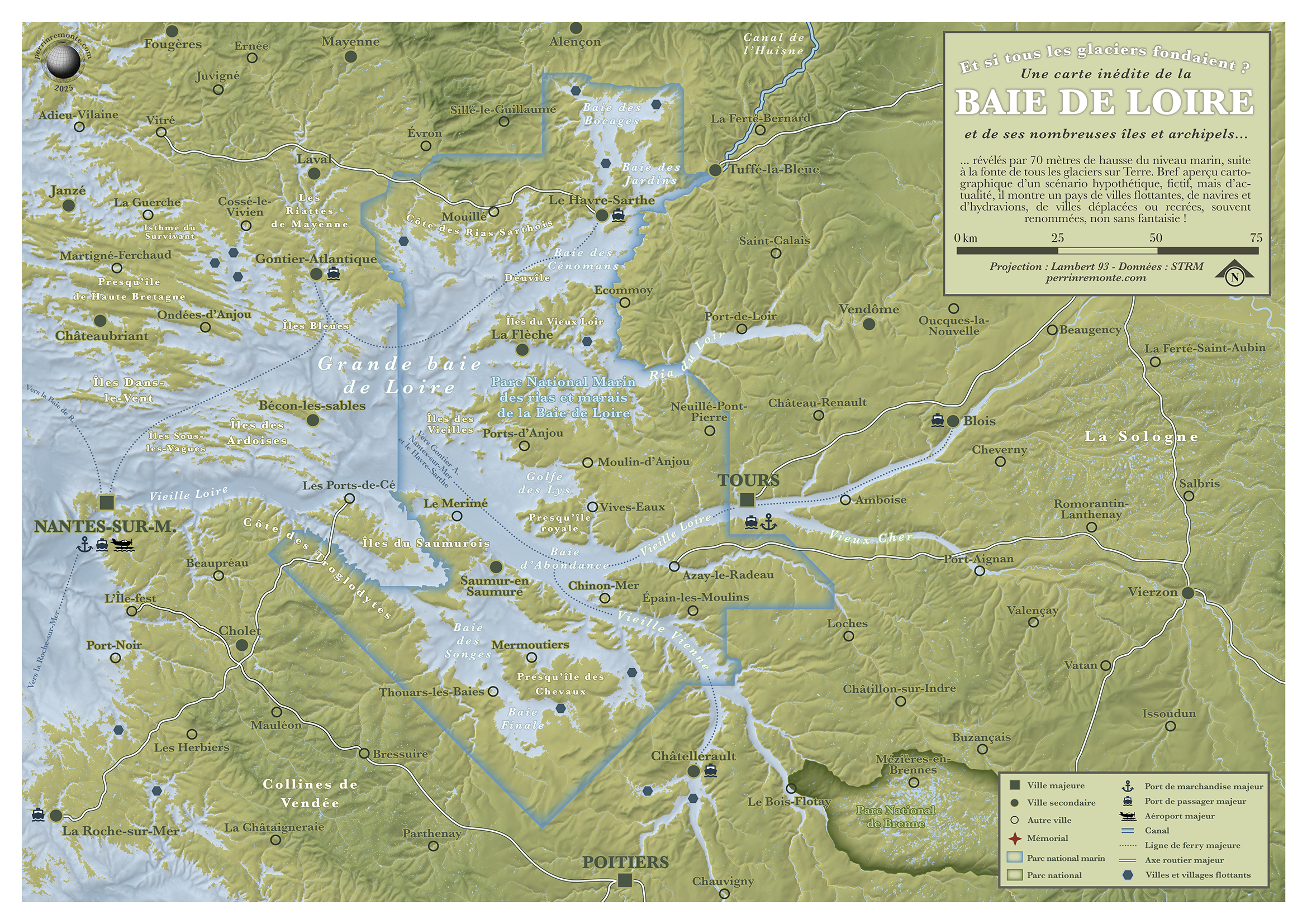
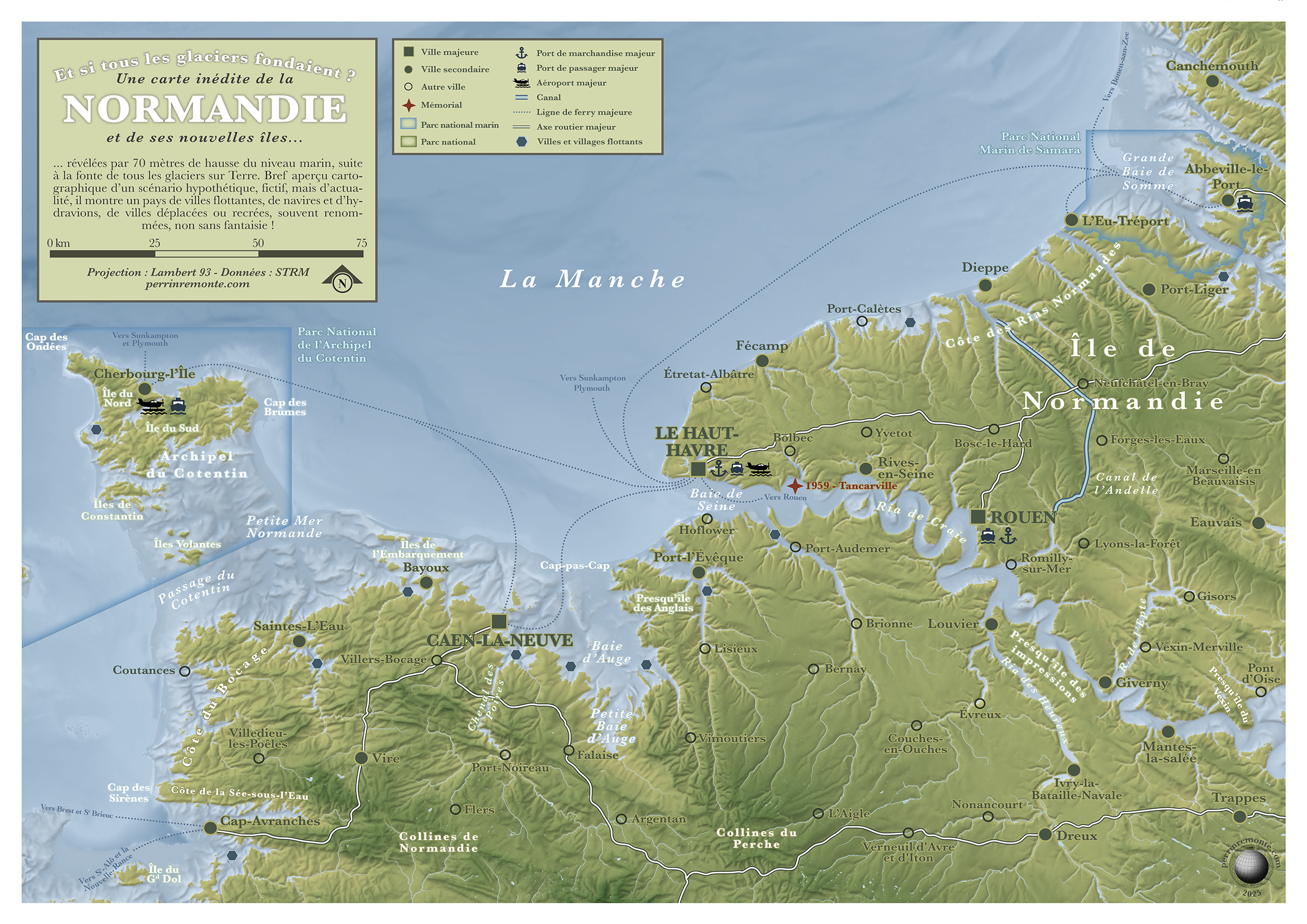
In this series of maps, discover the new regions of mainland France revealed by a 70-metre rise in sea level, following the melting of all the glaciers and ice caps on Earth. A brief cartographic overview of a hypothetical, fictional yet topical scenario, it depicts a country of floating cities, ships and seaplanes, of cities that have been relocated or rebuilt, often renamed – and not without a touch of fantasy!
Click on a map to enlarge it (series below)
Scroll down for the U.K version






Metropolitan France: Somewhere in the Future
Upheaval
The geography of France has changed somewhat — and for good reason: sea levels have risen by seventy metres. Enough to cause a few problems for a country that had invested heavily in its coasts for its cities, ports, tourism and industry.
On the menu in this future somewhere between the fantastical and the dystopian: new coastlines, submerged or relocated cities, new roads, bays and archipelagos. The economy and population have undergone radical changes too, in an effort to cope with rising seas. Even commercial airliners have given way to seaplanes, and a new golden age of sailing has begun!
Facing the Sea
The sea is rising, and humanity faces a choice: stand its ground against the water, retreat, or… adapt. The nine maps illustrate a mix of strategic retreat — cities rebuilt further inland, once sea levels have stabilised — and adaptation: floating villages, seaplane ports, and a massive reliance on boats for transportation.
In reality, adaptation goes much further in this half-dystopian, half-utopian future, with a new way of life more closely attuned to the environment and its resources, based around water and greater sobriety: plant- and sea-based diets to feed more people on less land, the widespread adoption of sailing, the transport of goods by barge…
Places have changed in many ways: their topography, their appeal — the sea has frightened many people away — but it has also created new opportunities for previously landlocked territories. Others have simply disappeared. The cards have been reshuffled!
The Paris region — renamed the “Îles de France” — has had to adapt at breakneck speed. The concentration of population, capital and infrastructure has made the rising waters of the Seine valley a colossal challenge.
Renaming
After the great flood that submerged nearly 15% of the country's land, another wave emerged: referendums to decide on the names of new municipalities, with citizens putting forward their own proposals, some more humorous than others. Other names simply emerged organically, reflecting a city's new activities or location, its transformed landscape, or its new arrivals…
Take Valenciennes and Cambrai, for example, which became Valencijn and Kamerijk after a wave of climate migrants from Dutch-speaking regions gradually imposed new spellings through everyday usage. Normandy has not been left behind either, with Canchemouth, located on a ria at the mouth of the Canche: probably the most British city in France, just after New Harbour a little further north.
Tourism
National parks, now more numerous, larger and better protected, have become natural refuges. Their expansion has pushed many populations towards cities, and more broadly towards the north, where the climate remains more habitable.
Amid the great wave of new place names, civil society has also revived the names of major figures in geography and ecology for some of these new parks, born from mergers or extensions of existing protected areas.
Transport
Air travel — now a rarity — is organised around a handful of small airports operating fleets of seaplanes, offering island communities and residents of some major cities a way to navigate the new geography and travel as they used to.
In reality, however, most journeys are made by bicycle, train or boat — including commuting to work. Former river valleys, now flooded, have become a new network of canals and maritime highways, free of tolls and facilitating domestic and international trade.
Meanwhile, new seaports and river ports structure this transformed France, adapted to a territory reshaped by water and entirely new patterns of settlement.